In Conversation with Nicholas Thompson
Restlessness, judgment, and keeping journalism alive.
In this conversation, Nicholas Thompson, CEO of The Atlantic, reflects on what it takes to steward a 168-year-old institution through the most disruptive era in its history: how he inherited a publication losing more than twenty million dollars a year and made it profitable, why his grandfather's Cold War legacy and his father's complicated life became the subjects of two of his books, what the AI threat to journalism really is, and his enduring mission to get more good stories into the world.
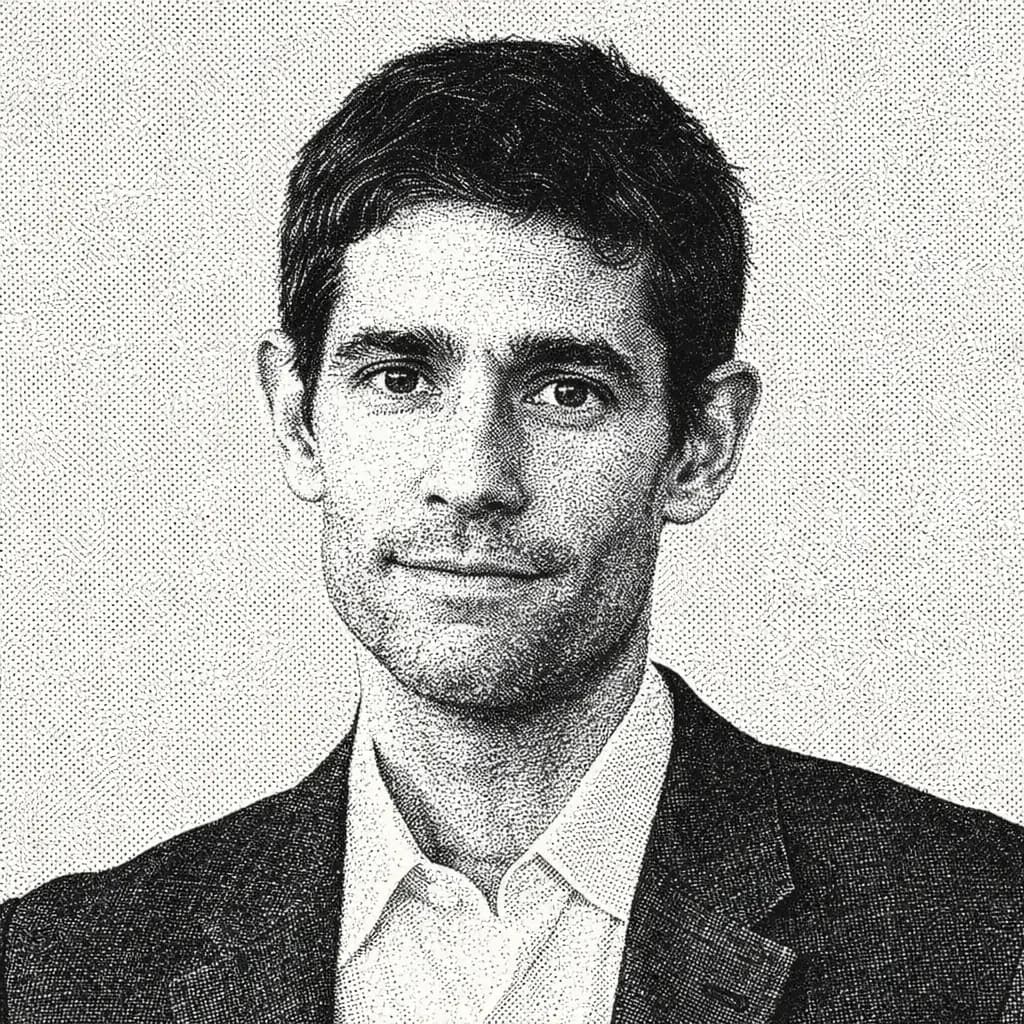
In 1997, Nicholas Thompson showed up for his first day at CBS's 60 Minutes. By the end of that day, he had been fired. Thompson was twenty-two, six months out of Stanford, and suddenly without a plan. He went to Africa with friends, and upon arrival was kidnapped by drug dealers in Morocco. That daylong ordeal became his first published story, a piece in The Washington Post. When he got back to New York, he couldn't find work for over a year. Eventually he landed at the Washington Monthly. In 2005, days before he was set to start law school at NYU, he took a job at Wired instead.
He edited the feature story that became the basis for Ben Affleck's Argo. He carried on a five-year correspondence with Joseph Stalin's daughter and turned it into one of The New Yorker's most memorable personal histories. He wrote a dual biography of his grandfather, Cold War arms negotiator Paul Nitze, and the diplomat George Kennan. For more than a decade, he ran 2:43 marathons. His teammates called him Mr. 2:43. Then, at forty-four, after surviving thyroid cancer and losing his father, he ran a 2:29 in Chicago. He got faster as the headwinds got stronger.
In February 2021, Thompson became CEO of The Atlantic, founded in 1857 by Emerson, Stowe, and their circle of Boston abolitionists. It has survived the Civil War, two World Wars, the collapse of print advertising, and the rise of social platforms that nearly bankrupted its peers. When Thompson arrived, it was losing more than twenty million dollars a year. Within three years, he had made it profitable and grown it to the highest subscriber count in its 168-year history.
That pattern — getting faster as the headwinds get stronger — turns out to be the pattern of The Atlantic itself: an institution that has found, again and again, that the conditions most likely to kill it are the same ones that clarify what it is for. Every previous threat to journalism disrupted how stories reached people. AI threatens the stories themselves. Thompson is not at all sure his magazine will outlast this one but he's already made the hard calls, and he's never been the type to slow down when things get harder.
On the Renaissance Man Problem
Gaurav Ahuja
Researching your background, the only phrase I kept coming back to was Renaissance Man. You're a competitive runner, you've written about deeply personal experiences, you're CEO of The Atlantic. We'll get into many of these in more depth. But how do you find balance between all of it: family, running, the job, you name it?
Nicholas Thompson
I've always been interested in lots of stuff, and that has always been a strength and a weakness. The smartest critiques of me have always been: he needs to really just focus on one thing. But I'm always focused on lots of different things.
It's funny you say "Renaissance Man," because that was the headline of the Stanford Daily profile of me when I was in college.
Gaurav Ahuja
That's incredible, I did not know that.
Nicholas Thompson
It's in the Stanford Daily archives. It's probably on my mind because they recently interviewed me again. I was on campus giving a talk, and they were going to write about it. They asked me about my time in college, and I said, "I actually don't have time to talk, but you can read the story in your archives." It's many thousands of words about my college years, written by the now-famous novelist Curtis Sittenfeld, who was a junior feature reporter.
I've always had this desire to do lots of different things, and it's just a trade-off. You're really focused on one thing, or you're focused on several things. I guess there's a third level, which is you're not focused on anything and you're just all over the place. I've always selected a number larger than one but smaller than ten of the things I'm really into.
Gaurav Ahuja
But it doesn't feel like the interests are shifting constantly. Running has been one of those things since age fifteen. Journalism has been one since college.
Nicholas Thompson
In my twenties, it was all music. I was putting out albums. I was playing around the city. That was my emotional release. But the more serious answer is that I've tried very hard to build a life where there is a lot of work, and I care deeply about my job. I think my job has meaning, and I try to do it well. And then I also try to have releases, moments where I can step outside of it and feel more alone with the world. And I care a ton about my kids and my family. So then you just have to balance it all, which is a challenge.
On Family, Pressure, and Parenting
Gaurav Ahuja
You had a unique childhood. Walk me through what was shaping for you, and then I want to bring it back to you as a parent now.
Nicholas Thompson
My dad starts to realize he's gay around 1980 or '81. I'm five or six. He leaves when I'm seven. That's obviously an extremely important moment. I'd been pretty close to him. I've always been more kind with my mother and exceptionally close to her, but I was close to my dad too. He moves to DC, and I see him a couple of weeks during the summer, see him for dinner on Mondays when he's in Boston. We stay very close.
My childhood was, for the most part, a blissful one. My mother and father are in this very complicated legal fight, custody issues, all of that, but I'm going to good schools, I have lots of friends, I'm on the soccer team, the basketball team. I do well, and I go to Andover. It's a pretty positive, safe, suburban childhood. Lots of books, lots of friends. I was lucky to grow up that way.
Gaurav Ahuja
Was there anything in that period that pointed toward journalism?
Nicholas Thompson
I wasn't considered a good writer. No one who knew me before the age of fourteen would have predicted journalism. If you took the subset of people who knew me then and asked them what Nick does, they would have predicted politics or public life. Maybe a TV host. I did a lot of drama. I don't think they would have said journalist.
The clue, though, was this personality of wanting to cover lots of things and move from one topic to another. That's the personality of a journalist. And being extroverted helps, because you like to talk to people. But a passion for writing? That didn't come until much later. I didn't write for the school paper in high school. I only wrote for the paper in college as an opinion columnist.
Gaurav Ahuja
So journalism wasn't obvious. But clearly something was driving you early on. People would have classified you as someone likely to be successful, even if not in the exact form it took. What was the core driver? Sibling competitiveness? Something with your father?
Nicholas Thompson
It was less sibling and more general family. My maternal grandfather was Ronald Reagan's chief arms negotiator. He's a very successful, very driven guy who works all the time and is basically telling everybody to work all the time. The expectation is you go to good schools and you work very hard.
I'm getting it from both sides: my father on the paternal side and then down the whole maternal line. I have a peer group of seven cousins. We went to Duke, Yale, Stanford, Brown, Harvard, Chicago. We're not competing with each other. It's just the expectation. My oldest sister goes to Yale, my other sister goes to Chicago. You work hard, you do well. It was never an option, and it was never something I turned on. My dad would see an A-minus and say, "But why not an A?" You got a little bit of pressure. But it never felt forced. I wanted to win the math award in fifth grade.
Gaurav Ahuja
Is that the same expectation you set with your own kids?
Nicholas Thompson
I'm much looser. I definitely do not put the same pressure on them that my dad put on me. They may have the same atmospheric pressure: cousins, family, just being around others who are driven. But I've tried very hard not to do what my dad did.
Gaurav Ahuja
Why is that the better route?
Nicholas Thompson
I can see how that kind of pressure worked with me. I can also see how it backfired with peers. There's a real risk.
Gaurav Ahuja
How do your kids not grow up entitled, given the world they're in?
Nicholas Thompson
My oldest goes to a fully test-based public high school. You don't get in because your dad is CEO of The Atlantic. You score well, get in, and get your ass kicked by immigrant kids. You go through that, you're going to be okay.
My middle kid plays soccer on this very intense team in Queens. We're probably the only parents both born in America. He plays in a league where everybody speaks Spanish. The ref yells at him in Spanish. He's exposed to different cultures, toughness, masculinity, all through soccer. Every weekend he's out in a field in Queens getting knocked down.
And then there's the meritocracy of it. In soccer, nothing I can do gets you on the A team. The only way you get on the A team is you have to be better. Dad can't help. Same with running. You can have all the connections in the world. If you run a five-oh-one mile and the next kid runs a five-flat, you lose.
On False Starts
Gaurav Ahuja
You get a job at 60 Minutes. And you get fired on the first day. How do you both land that job without being sure journalism is your path, and then lose it?
Nicholas Thompson
That's the irony nobody asks about. Why did I get hired? I shouldn't have been. My journalism experience was nothing. I'd written some op-eds. I was hired because I was charismatic and charming, and the person hiring just wanted somebody smart who could carry camera equipment across the mountains of Chiang Mai and memorize the names of every staffer in Washington. She saw potential. But I definitely did not deserve the job based on any actual accounting of experience.
So I show up, and the executive producer sniffs out that I don't have the credentials and fires me. The hiring decision-maker and the boss were two different people. The producer was told she could hire an associate producer. I come in. The executive producer asks, "Who's the new kid?" And then I'm out.
Gaurav Ahuja
First job out of school, you're probably over the moon, and then it's gone. Where do you go from there?
Nicholas Thompson
It wasn't as deflating as it could have been because I was like, "Screw this." That was December 1997. I graduated June '97, spent the summer on a scholarship, spent extra time playing guitar. Everything's fine. I get the job, I get fired, and I wasn't that broken up because everything still felt okay.
Then I go to Africa with my best friends from college. I come back in March, and that's when it starts to be a problem. I'm applying for jobs and I can't get one. It's a short period in retrospect, March '98 to September '99, but I'm playing music in the subway, putting out flyers, exploring music as a career path. I applied to a hundred places. Eventually I did an internship with the Environmental Defense Fund, then I got hired by a tech company to work in marketing at this Linux hardware company, and then I got hired at the Washington Monthly. There were two periods in my life where I felt professionally adrift. That was the first. The second was after the Washington Monthly, a good five years until I got hired at Wired.
On Timing and the Business of Media
Gaurav Ahuja
At both Wired and The New Yorker, you were working during a time of great industry upheaval: the web transforming journalism, mobile arriving, platforms like Facebook and Twitter starting to own the links. At first you were a journalist, then an editor in chief, and eventually someone owning more of the business. There was this consistent theme of being with the times in a way others weren't.
Nicholas Thompson
What I didn't realize at the time was how valuable the Wired experience was. I got hired there when I was thirty, in 2005. It's right at the MySpace era. Facebook is coming, 2007 is around the corner. I'm editing stories and just observing, but you learn so much. I was in New York but also going out to Silicon Valley. You learn how venture capital works. You learn how tech companies run tests. Then three or four years in, I take on my first startup, a multimedia magazine I launched right when the iPad launched.
So I get hired at The New Yorker with all this relevant experience about the tech industry, about how Facebook's recommendation engines work, about being an early user of LinkedIn. And I arrive at a place where every single person is an English major. Gradually they're like, "Maybe Nick should be in charge of our iPhone app. Maybe the iPad app. Maybe the website. Maybe the product and dev team." I just had slim credentials in that area, but The New Yorker likes to hire from the inside because they want people who understand the culture and know how a New Yorker story is edited. If you're the person who is a good editor and also knows the most about how an engineering team should be structured, you get the engineering team, even if you don't know all that much about engineering teams.
Gaurav Ahuja
What were you embracing that the industry wasn't?
Nicholas Thompson
I think it might just be that David Remnick timed it right. He essentially ignored the internet from 1999 to 2012, and it turns out that was the right strategy. Everybody who embraced the web early, look at The Atlantic versus The New Yorker. The Atlantic was all-in on the web. It starts blogs, launches Atlantic Wire, CityLab. Its president is blogging nonstop. Remnick looked at that and said no. Then one day he decided, "Maybe we should do some of that, but we're not going to launch a wire service or daily blogs. We're just going to do high-quality stories." He put me in charge.
The New Yorker always had a paywall. The content was never free. Part of the reason The Atlantic got into trouble in the late 2010s is that they didn't have a paywall. And you can't introduce one when Andrew Sullivan is blogging for you in the open. So The New Yorker kind of backs into the right strategy by getting it wrong initially. We timed it right. Web advertising declines dramatically, but we're fine because we're not dependent on it. We're driving digital subscriptions. And we never got too close to the social companies because we were paywalled. Facebook goes away as a traffic source, and that's devastating for Vox and HuffPost, but it doesn't really affect us.
Gaurav Ahuja
How was the transition from being a journalist, where your north star is quality content, to embracing the business side?
Nicholas Thompson
It was subtle and accretive. I wasn't just a writer. I was an editor. I managed people. I liked managing people, working with teams. Sometimes people ask me what it's like to be CEO after being a journalist, and I say: there are ten things you do as a CEO. I started doing one at The New Yorker, then two, then three. At Wired, I was doing six, then seven, then eight. By the time I came to The Atlantic, it was just a tenth thing. It was like crossing a river on a log, one step at a time. I didn't quite realize it, but I was steadily taking on new business responsibilities.
I remember learning the difference between a project manager and a product manager. Trying to explain it to David Remnick. "The project manager just does a project. The product manager thinks about the whole thing." "Well, can't the product managers do the engineering?" "No." "What about the journalist we have who took a coding class in college?" Learning all of that was part of my New Yorker education.
On the Hits Business and Taking the Reins
Gaurav Ahuja
There are these specific moments that get idolized in a career: your first article from Africa, the US News & World Report fraud story, Signal Gate. Is the right way to think about it like a venture portfolio, where you release a hundred things and two or three are outsized stepping stones?
Nicholas Thompson
In journalism, we often say it's a hits business. You just don't know what the hits are going to be. You publish all these stories. Did I put more work into the US News story than average? Maybe a little more. But sometimes things just happen, and a big breakthrough changes your perception.
The other thing that changed my career enormously was my book on the Cold War. That changed my reputation. Suddenly I went from being an editor to this guy who wrote a whole history of America in the Cold War, and people loved it. It's something to do with why I was hired at The New Yorker, probably. Because it showed I had the wherewithal to sit down and get it done, and people who read it thought it was good. It moved me from being an editor to being more of an intellectual, a different plane.
Gaurav Ahuja
You've also been more personally open than the average journalist. Has that been intentional?
Nicholas Thompson
I sort of don't love that kind of journalism, actually. I edited Dexter Filkins, who never used the word "I" in a story. He wouldn't even say "told me." It was always "he said." I admired that. I really didn't like unnecessary use of the first person. But it's also true that I had this amazing grandfather and this crazy father, and every now and then something interesting has happened to me. So I have written about that stuff. I do feel a little awkward that I've written two books, one half about my grandfather, the other half about my dad. I'm kind of running out of ancestors.
Gaurav Ahuja
How did the CEO role at The Atlantic come about?
Nicholas Thompson
David Bradley approached me and said the CEO job was open. I said sure, let's talk. It took a long time for them to settle on me. Many months between when we first talked and when they made the offer, which was February 2020. I started in January 2021.
Gaurav Ahuja
Was the role connected to the new ownership?
Nicholas Thompson
Not directly. The new ownership came in around 2017. This had to do with the strategy not working. They had huge layoffs in 2020, a big chunk of the staff. After that, they decided they needed a CEO with a mandate to make the place profitable. They began hunting, talked to a ton of people, and eventually they ran out of other candidates and I was the last one left.
Gaurav Ahuja
That sounds very humble.
Nicholas Thompson
I think they've been on the record saying they talked to a lot of people.
Gaurav Ahuja
From losing more than twenty million dollars a year to profitable, and now the highest paid subscriber count in the publication's history. A remarkable turnaround. When you were evaluating the role, did you feel like there was obvious low-hanging fruit based on your Wired and New Yorker experiences?
Nicholas Thompson
I hate saying it, but I sort of did think it would be fairly easy to make the place profitable. From what I knew about their traffic numbers, it seemed like it should work. It was harder than I expected and took a while. But that wasn't why I took the job.
I took the job because it seemed like something I'd be good at. I was ready to be back in the political world. And there was this interesting calculus: media is so under threat. Even back then you could see AI coming. I figured, if I'm good and media survives, great. If I'm good and media is toast, I can go be a CEO somewhere else. If I'm not good, I'll just go back to being a writer. It's very rare that you take a CEO job because it increases professional optionality, but that's what it was.
On AI and the Existential Threat to Journalism
Gaurav Ahuja
You mentioned seeing AI coming even before ChatGPT. What did you mean by that?
Nicholas Thompson
At Wired, we started covering AI aggressively. We had a full-time AI reporter when I started in 2017, and then multiple. We wrote one of the first stories about OpenAI. I certainly didn't know chatbots were coming, but if you cover Moore's Law enough, you recognize what it feels like to be in the early part of an exponential curve. I used to give talks where I'd show a chart of Moore's Law and say: this is where AI is, but this is where it's going.
Gaurav Ahuja
If The Atlantic needs to survive another century, AI is clearly the challenge to solve. How does this moment feel relative to the internet's early threat to media, or the era when platforms started flexing their muscles?
Nicholas Thompson
What's interesting about those earlier changes is that both were seen initially as only good. The web comes along and it's amazing. You can publish, you can do things differently. People don't quite figure out that it's going to eat the advertising model. Social media is the same: a cool way of reaching people, great, until the platforms change their policies.
With AI, you can see from day one that it could completely supplant what we do. The internet and social media disrupted distribution and advertising. AI disrupts the creation of content. It disrupts the process of thought. It's much more terrifying.
Gaurav Ahuja
You've played both offense and defense with it. You created a custom GPT for running. You've described using AI as a devil's advocate for articles. You partnered with OpenAI. But you've also talked about defensive measures with Cloudflare and the idea that AI labs should be sending value back to publishers. Realistically, how does that play out?
Nicholas Thompson
My view is that in order to anticipate how AI is going to change your business, you have to use it. Anybody who doesn't use it every day is foolish, both because it's so helpful and because you're missing an opportunity to understand the thing that's changing your business.
It's not necessarily contradictory to believe it might destroy your business and that it might also be great. It could end up that we figure out how to use AI to reach people in new ways and make better stories. The Atlantic might still exist as a print publication, a digital website, an app, podcasts, and video, all just better because we use AI. That's entirely plausible. It's also entirely plausible that the moat we have, doing better stories than AI can, disappears. Maybe a super powerful model can write stories as good as ours. But will people want to read them? People hate AI-generated content.
My job is to try to get closer to those answers before other publishers and as soon as possible.
Gaurav Ahuja
Is there a steady state of what journalism becomes in a world of AI?
Nicholas Thompson
I can't see out twenty years. We've been sending magazines by the United States Postal Service since 1857. We'll still be doing that in twenty years. The interesting question is digital. Will there be a digital Atlantic? What happens to the app?
The big risks are real. Will AI search eat the web? Will Google stop sending people out? If so, what happens to us? What if we shift from screens to whatever Jony Ive is building, wristbands with no screen, all audio? We don't have as aggressive an audio operation as we do text. There will still be people who read words. But you can imagine words becoming less and less of the world. And we're really good at words.
On Emerson's Magazine
Gaurav Ahuja
The Atlantic started in 1857. Its first issue championed the abolition of slavery. It published Mark Twain, Walt Whitman, Martin Luther King Jr.'s "Letter from Birmingham Jail." How did it become that go-to place?
Nicholas Thompson
There's a real intellectual community in Boston in the 1850s: abolitionists, writers, thinkers. It's not just Emerson. It's Thoreau, Harriet Beecher Stowe, Oliver Wendell Holmes, James Russell Lowell, Nathaniel Hawthorne. They're friends, and they happen to start this magazine. So many of the best writers of the nineteenth century were in one place and started it together.
The interesting question is why this one lasted. Lots of journals were started by amazing people. We went through rocky periods. The 1890s weren't our best era. There was some anti-immigrant racism we're not proud of. But we had a relatively small number of editors who were mostly great, served roughly ten-year terms, and handed it to the right people. They were custodians of a publication they cared deeply about.
Gaurav Ahuja
Does that history influence how you run it today?
Nicholas Thompson
It influences Jeff Goldberg on the editorial side more than me. We have a manifesto: we are a writer's collective, of no party or clique, a magazine of literature, culture, and arts. It only inspires me in that it would be a real bummer to be the CEO who blew up Ralph Waldo Emerson's publication. It's extra motivation. And it's good for the brand. We've been on the right side of the hardest issues. The hardest issue in America is race, and we've been consistently on the right side of it since 1857.
On Hard Calls, Judgment, and the North Star
Gaurav Ahuja
When you took over, there had to have been some hairy decisions underneath the turnaround. Tell me about the hardest ones.
Nicholas Thompson
One was tightening the paywall. We ran studies on whether the economics were better if you let people read four stories a month before asking them to subscribe, or three, or two, or one, or zero. I came in expecting two or three. It turned out the answer was basically zero. A hard paywall, a meter that comes down the first time someone visits.
The problem is you're limiting reach. You're contributing to a world where good information is expensive and bad information is free. That's a real trade-off. When I started, even talking about a hard paywall was considered toxic internally. Getting there took a lot of conversations, and I had to be convinced of it. But it was a huge part of our success.
The argument over profitability itself was hard to win. A lot of people were like, "Our owner is a billionaire. Why would we sacrifice the great work we do just to put money in her pocket?" I had to explain: the deal is we're going to be profitable. If anybody wasn't up for that, this wasn't going to work.
Gaurav Ahuja
Is there anything you changed that you wish you hadn't?
Nicholas Thompson
The most controversial thing I did was the OpenAI deal. The editorial side saw it as a deal with the devil. I wish I had introduced it differently so the staff didn't reject it so hard. But in retrospect, I would have done deals with every AI company. The price of training data has gone way down since then because of synthetic data, which the AI companies themselves didn't know at the time. Thank God we did that deal when the price was high. I feel like we missed out on opportunities in that period because of all the anger over AI. I wish I had said, "I see where this is going, and I'm going to act on it," and done deals with Perplexity and everyone else. Similar to the Reddit strategy: they did deals with all the major labs.
Gaurav Ahuja
There are a lot of very wealthy owners taking over media publications right now. Contrast that with intellectuals like Emerson starting journals in the nineteenth century. How is this changing media?
Nicholas Thompson
The era of wealthy owners is a function of the business model not working. When the business model fails, you need benefactors. We have the world's greatest benefactor, and she requires us to run it like a business. But the history of publications taken over by wealthy owners is not great.
In the best possible scenario, you have complete editorial independence and only pursue the truth. What happens with wealthy owners is they often say, "Oh, you shouldn't write that story," or "That's a mean story about my friend." You don't want that. You don't even want to be thinking about it.
The ideal ownership structure would be to not even know who owns you. To be totally independent. That's the highest form.
Gaurav Ahuja
Let me shift to a very different kind of judgment call. Could you take me behind the scenes of Signal Gate?
Nicholas Thompson
I knew the team had something really big related to national security, but I didn't know the specifics. If they had told me, I would have been potentially in legal jeopardy. Anyone who knew the topic was. So I had to build scenario plans for cybersecurity, office security, audience development, without knowing exactly what the story was.
The morning it came out, I probably had more anticipation than anybody else in the building, because I knew just how big it was but I didn't know what it was exactly.
Gaurav Ahuja
When you hear something that big is coming, is it excitement or fear?
Nicholas Thompson
All excitement. I told Jeff, "I don't know what the story is, but I support you a hundred percent." I was only amped that day.
Gaurav Ahuja
Aren't there situations where a story that big could alienate readers or complicate relationships?
Nicholas Thompson
Sure. But I trust Jeff. If I didn't trust him, that would be different. I did ask him: "Are you certain this isn't some kind of setup? That we're not being conned, like a James O'Keefe thing?" He said yes. As long as that wasn't the case, I was good.
Gaurav Ahuja
Last question. Fast forward. You're a hundred years old. What's the North Star that took you from 2025 CEO of The Atlantic to a hundred-year-old Nick?
Nicholas Thompson
If there's one decision framework I use, it's this: which choice will allow me to get more good journalism into the world so that American democracy works better? You can write stories and do that. You can edit stories and do even more. If you give me some credit for making the finances of The Atlantic more stable, look at all the good stories we've put into the world as a result. That will be my North Star for the rest of my career: what is the thing I can do that will most increase good stories in the world? It's probably influenced by my grandfather. He spent his whole life trying to make America work. My role is to try to do that through journalism.
The opinions expressed in this newsletter are my own, subject to change without notice, and do not necessarily reflect those of Timeless Partners, LLC (“Timeless Partners”). More...
Nothing in this newsletter should be interpreted as investment advice, research, or valuation judgment. This newsletter is not intended to, and does not, relate specifically to any investment strategy or product that Timeless Partners offers. Any strategy discussed herein may be unsuitable for investors depending on their specific objectives and situation. Investing involves risk and there can be no assurance that an investment strategy will be successful. Links to external websites are for convenience only. Neither I, nor Timeless Partners, is responsible for the content or use of such sites. Information provided herein, including any projections or forward-looking statements, targets, forecasts, or expectations, is only current as of the publication date and may become outdated due to subsequent events. The accuracy, completeness, or timeliness of the information cannot be guaranteed, and neither I, nor Timeless Partners, assume any duty to update this newsletter. Actual events or outcomes may differ significantly from those contemplated herein. It should not be assumed that either I or Timeless Partners has made or will make investment recommendations in the future that are consistent with the views expressed herein. We may make investment recommendations, hold positions, or engage in transactions that are inconsistent with the information and views expressed herein. Moreover, it should not be assumed that any security, instrument, or company identified in the newsletter is a current, past, or potential portfolio holding of mine or of Timeless Partners, and no recommendation is made as to the purchase, sale, or other action with respect to such security, instrument, or company. Neither I, nor Timeless Partners, make any representation or warranty, express or implied, as to the accuracy, completeness or fairness of the information contained in this newsletter and no responsibility or liability is accepted for any such information. By accessing this newsletter, the reader acknowledges its understanding and acceptance of the foregoing statement.